
SaaS Google Ads: Freelancer or Agency?

The short version
- Decide what the work is first. Building an account is a project with an end; running one is weekly work with no end date.
- A freelancer suits a build and handover, or a simple account, because the person you hire is the person in the account. The risk is continuity.
- An agency suits a job bigger than the ad account, and only when someone on your side can brief it.
- An in-house hire suits paid search that already fills a week, with someone able to judge the work.
- Whoever you hire, create the Google Ads account under your own login and keep admin.
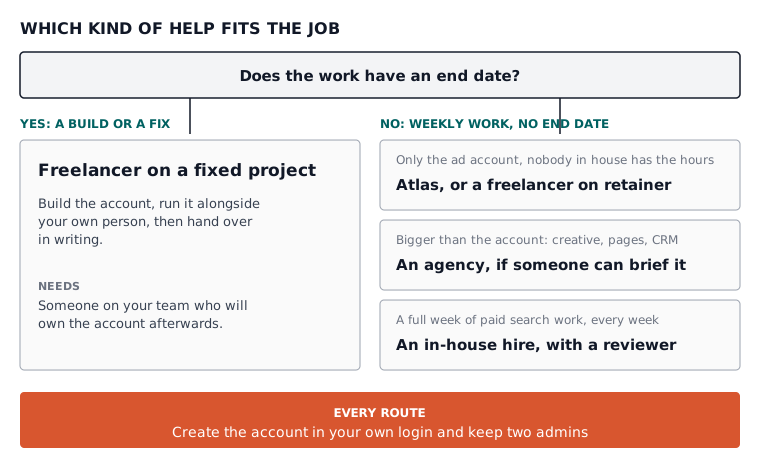
Hire a freelancer when the job has an end: build the account, prove the tracking, hand it to someone on your team. Hire an agency when the work is bigger than one ad account and you have someone who can brief it. Hire in-house when paid search already matters enough to fill a person’s week. For most early B2B SaaS companies, the deciding question is not who is cheapest. It is who will still be reading your search terms report in month seven, and whether you can see their work without asking.
A thread on r/googleads put the question in its most useful form. A B2B cloud and DevOps consultancy wanted one person to launch and structure its campaigns, set keywords and negatives, write the ads, do the first round of optimisation and then hand the account to an in-house team. It is a sensible brief, and the one most sellers steer you away from, because a retainer is a better business than a handover.
Decide what the work is before you decide who does it
There are two jobs hiding in this question, and they suit different people. Building an account is a project: conversion tracking, campaign structure, keywords, negatives and ads, done once and done properly over a couple of weeks. Running it is weekly work with no end date: reading search terms, adding negatives, rewriting ads from real data and moving budget towards whatever converts.
Most bad hires come from mixing the two up: a monthly retainer for what should have been a fixed project, or a builder expected to keep reading the search terms report after the invoice is paid. Name the job you are buying first, then pick the shape of help that fits it. And on a very small budget, hire nobody yet: a week of it does not produce enough data to decide anything, so you would be paying someone to wait.
When a freelancer is the right call
A freelancer is the right call when the job has an edge to it: a build, a fix, or a simple account that needs a few hours a week. The advantage is one an agency cannot match by design, because the person you speak to is the person in the account. Nobody pitches you and then hands the work to someone you have never met, a pattern we unpack in who really runs your SaaS ads account.
The weakness is continuity. One person means one inbox, one holiday and one illness away from nobody reading your search terms for a fortnight, and it means nobody reviews their work. A good freelancer raises both points before you do, and writes down why the account is set up as it is, so it survives them. Signs a freelancer fits:
- The work is a build or a fix with a clear finish line.
- One product, sold in one or two countries, to a buyer you can name.
- Someone on your team will own the account afterwards, even for an hour a week.
- You would rather talk to the operator than to an account manager.

When an agency earns the retainer
An agency earns its retainer when the work is bigger than one ad account. Positioning, landing pages, creative, attribution wired into your CRM and paid social alongside search are several specialist jobs, and an agency has a bench of people for them plus someone senior to check the work.
The cost of that bench is distance. Senior people tend to sell and supervise while more junior people do the weekly work, and the account manager may change more than once a year. That belongs in the price, and our breakdown of what a SaaS PPC agency costs puts published retainers next to real budgets. The other condition sits on your side of the table: an agency needs someone in house to brief it and act on what it recommends, or its best work lands in a shared folder and stays there.
If the honest need is someone acting on the account every week, read what agencies do that software cannot first.
When to hire someone in-house
Hire in-house when paid search is already a core channel and there is a full week of work in it. That usually means several campaigns across more than one product or market, paid social running alongside search, landing page tests in the queue and a sales team asking about lead quality every Monday. Below that, a salaried specialist spends half the week waiting for data.
The in-house risk is the freelancer’s risk with a notice period attached. You get one person, no peer review, and often a founder who cannot judge the work they are paying for. If you hire, find them a second pair of eyes from somewhere, and make sure the account, the billing and the conversion tracking are in the company’s name rather than theirs.

What a one-off build and handover should include
A good build and handover leaves you with a working account, proof that the tracking fires, and a person on your team who understands why everything is set up the way it is. The deliverable is the campaigns plus the reasons, written down, plus a few weeks of the builder and your person working side by side. Here is how we would scope it, over about eight weeks:
- Build, weeks 1 to 2. Conversion tracking tested against a real signup or demo booking, brand and non-brand campaigns split, phrase match by default with exact kept for brand terms, a negative list in place before launch, and everything launched paused for your review.
- Run alongside, weeks 3 to 6. The builder and your person read the search terms report together every week, add negatives and rewrite ads from real data. The budget is never more than doubled inside a month, so you can still tell which change did what.
- Hand over, weeks 7 to 8. A written account notes document, the builder stepped down to Read-only access or removed, and a final review call.
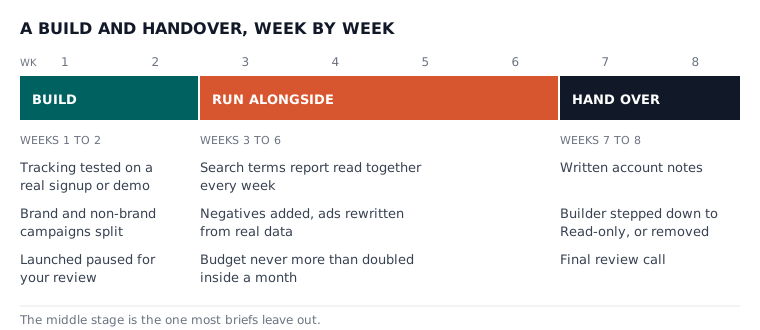
Agree a fixed project fee with the run-alongside weeks included, and ask for the notes document by name, because it is the first thing a busy builder skips.
Keep the account in your name, whoever you hire
Whoever you hire, create the Google Ads account yourself, under your company’s own Google login, and keep admin access. Google’s page on manager account ownership says a client account can only have one owner, and that if a manager account creates a new account, it automatically becomes the owner (read 15 October 2026). A freelancer who builds from their own manager account therefore starts out owning yours.
That can be fixed, but it is easier to avoid. Google’s page on access levels lists five levels, from Email-only to Admin, and only an Admin can give account access or change access levels (read 15 October 2026). Give the person doing the work Standard access, which can edit campaigns, and keep two admins on your side. The same page warns that an account with only one admin may lose access to its tags if that person becomes unavailable, which is the continuity problem in one sentence.
At handover, check the change history for a week afterwards to confirm the new owner of the work is actually in there. Our guide to switching SaaS PPC agencies covers the same steps for when a relationship ends less tidily.

Where Atlas fits between the three
Atlas is a fourth option for the job most SaaS companies actually have: an account that needs building once and running every week, with nobody in house to do the weekly part. Atlas is an operator, not an assistant. It connects to your own Google Ads account and drafts the full structure there within an hour, paused, with every choice explained in plain English, and you review it before anything goes live.
From then on Atlas does the weekly work on search terms, negatives, keywords, ads and budgets, and you set the boundaries. You pick the approval tier, Manual, Smart or Full Auto. Every change passes rule-based safety rails first, anything that fails them waits for you, and you can undo any Google change within 30 days. Atlas works inside your account through the access you grant, so there is no handover to manage: the account was always yours. Rob Walling of MicroConf put it in one line: “Think of it as an agency team in a box.”
Atlas is £149 a month. Atlas + Human is £299, with a professional ads manager from our team who approves, adjusts or corrects each Atlas decision, and Atlas VIP is £1,299 with a monthly strategy call and hands-on work in your account. The free plan sets up conversion tracking, though Atlas does not run live ads on it. There is more on launching Google Ads for SaaS, on running Google Ads for a SaaS product and on what Atlas does each week.
Hire for the job, then keep the keys
Write down which job you are buying before you talk to anyone. If it is a build, hire a freelancer on a fixed project with a run-alongside period and a written handover. If the job is bigger than the account and you can brief it, hire an agency. If paid search already fills a week, hire someone and give them a reviewer.
In every case, create the account yourself and keep two admins, and run your search terms export through our free search term analyser once a month to see whether anyone is reading it. If you would rather have the weekly part done without hiring at all, start on the free plan at app.saasadsstudio.com and get conversion tracking right first.
Questions people ask about this
- Can I remove a freelancer's or an agency's access myself?
- Yes, as long as you hold admin access. Google's access levels page says only an Admin can give access, change access levels and unlink manager accounts. Its page on manager account ownership adds that your account keeps its own data and can remove a manager's ownership by unlinking it. So one admin login should always sit on your side.
- What is the difference between a user login and a linked manager account?
- A user login is one named person with one access level in your account. A manager account is the freelancer's or agency's own account, linked to yours. Google says that once you accept a manager link, users with admin access to that manager account can manage your campaigns, so the list of people able to touch your account then sits with them.
- Should I ever let a manager account own my Google Ads account?
- Rarely. Google recommends making a manager account the owner only if it actually needs the privileges ownership brings, such as adding and removing your users. Ownership is also transitive, Google says, so every manager account above the owner inherits it too. For someone simply doing the work, a link without ownership is enough.
- Does Atlas need its own user login to my Google Ads account?
- No. Atlas works through the access you grant it via the Google Ads API, inside your own account, and you can revoke that access at any moment. You stay the owner of the account and the billing, and strategic decisions such as new campaigns, big budget shifts or a new market still come back to you.
- Is there a minimum term on Atlas?
- No. You can cancel at any time through the app, and cancellation takes effect at the end of your current billing period. Fees are non-refundable, prices exclude VAT, and your account data is kept for three months after you cancel in case you come back. No plan carries a guarantee of results.
