
What Agencies Do That Software Cannot

The short version
- An agency sells you decisions, the hours to carry them out and someone who answers for the result. Software sells you the finding and leaves the doing.
- Every serious tool in this category ends with a person clicking apply, by design. Opteo’s own site says improvements are pushed live by you, and Optmyzr’s says its rule engine previews every change so that the automation never gets ahead of you (both read on 1 October 2026).
- Google already gives you the suggestions free on its Recommendations page, with an optimisation score that moves when you act on them. The missing piece is rarely the advice.
- Below about £1,000 a month of ad spend, a week holds too little data for anyone to decide anything, so neither an agency nor a tool earns its fee.
- Atlas is the third answer: it runs Google Ads week to week at the approval tier you set, from £149 a month, and £299 a month puts a human over every decision it makes.
An agency gives you three things a tool does not: a decision, the hours to act on it, and somebody whose job it is to answer for the result. Software gives you the first half of the first one. It watches the account, works out what is wrong, and puts a suggestion in a queue. Then it waits for you. If your week has no spare hour in it, that queue becomes a standing reminder that your ads need work, which is not the same thing as the work being done. So the question is not really agency or tool. It is who does the weekly work, and what you are willing to pay for that.
What you are actually paying an agency for
Judgement and execution, not reporting. A good SaaS PPC agency decides what the account structure should be, which terms deserve their own ad group, where this month’s budget moves and what gets switched off. Then someone does it, and explains the thinking on a call where you can push back. The monthly report is the receipt, not the product.
That distinction is worth holding onto, because the common failure is an agency that built a decent account in month one and has been sending a report ever since. The threads where founders swap agency stories are full of that pattern: the setup was fine, the number arrives on time, and nobody has read the search terms or opened the landing page since launch. When we take over an account like that, the structure is rarely the thing that is broken. Four months of nobody looking is the thing that is broken.
So the useful version of the hiring question is not whether agencies are worth it, but what happens in week three. Three things are worth asking before you sign:
- Who will be in the account, how often, and for how long each time?
- What did they change in another client’s account last week?
- Having looked at ours, what would they switch off first?

What software does, and where it stops
It finds the problem and hands it back to you, on purpose. That is the design of the category rather than a flaw in it. Opteo’s own site, read on 1 October 2026, describes continuous monitoring of Google Ads accounts for statistically significant patterns, with an improvement that can then be pushed live to your account in a few seconds, and its own getting-started steps finish with you pushing improvements. Optmyzr’s comparison pages, read the same day, make the same promise from the other end: the rule engine can run in a suggestions mode where you approve, edit or discard every proposed change, so that the automation never gets ahead of you.
That is a fair thing to sell, and both are good at it. It is also close to what a two-person growth team already has for nothing. Google’s own Recommendations page sorts its suggestions into bidding and budgets, ads and assets, keywords and targeting, and repairs, and the score beside them, which Google describes as an estimate of how well your account is set to perform on a 0 to 100 per cent scale (read 1 October 2026), moves as you apply or dismiss them. Paying for a tool on top of that buys sharper prioritisation and much better search term analysis, which is real value. It still ends the week needing somebody to act.
The weekly loop is the whole job
Four checks, every week, in the same order, and most of the money wasted in a B2B SaaS account goes on skipping them. Read the search term report and add negatives for anything that was never going to buy. Check pacing against the budget. Separate what converted from what merely clicked. Then change one thing rather than six, so next week’s numbers still mean something.
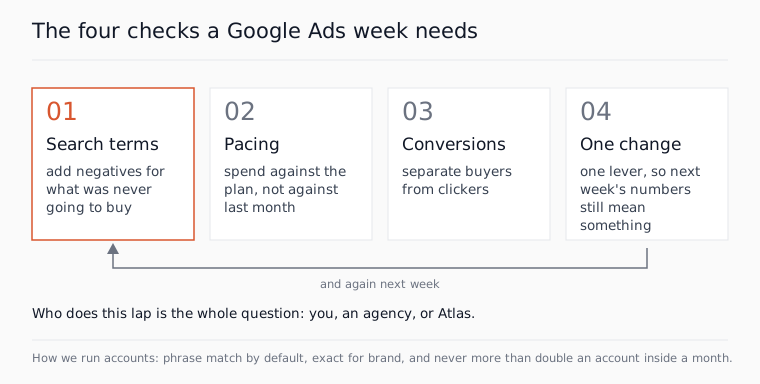
Here is how we run Google Ads for SaaS, so you can copy it or judge an agency against it: phrase match by default and exact match for brand, because broad match is where non-brand budget quietly goes; never more than double an account inside a month, however good the week looked; and one lever at a time. Our free search term analyser does the first of those checks, and it will do it whoever is running your ads.

When the agency fee is worth it, and when it is not
It is worth it when the work is genuinely hands-on and the spend can carry the fee: several markets, a sales team whose closed-won data has to find its way back into the account, a long cycle where LinkedIn creates the demand that Google later converts, or a founder who knows perfectly well they will never open the account. At a large enough budget, a specialist costs less than the waste they prevent.
It is not worth it at the other end of the range. Below about £1,000 a month of spend, a week does not hold enough data for anyone to decide anything, so you are paying a retainer for patience. If conversion tracking is missing, nothing anyone does can be judged, so fix that before buying either. And if you sell direct to consumers out of a product catalogue, most SaaS paid search advice, ours included, is the wrong shape for you.
What a management fee costs as a share of your budget
Put the fee next to the spend it comes out of, because that ratio decides more than any feature list does. On a £3,000 a month budget, the middle of the £1,000 to £10,000 band this product is built for, Atlas at £149 a month is about 5 per cent of what you are spending, Atlas + Human at £299 is about 10 per cent, and Atlas VIP at £1,299 is about 43 per cent.
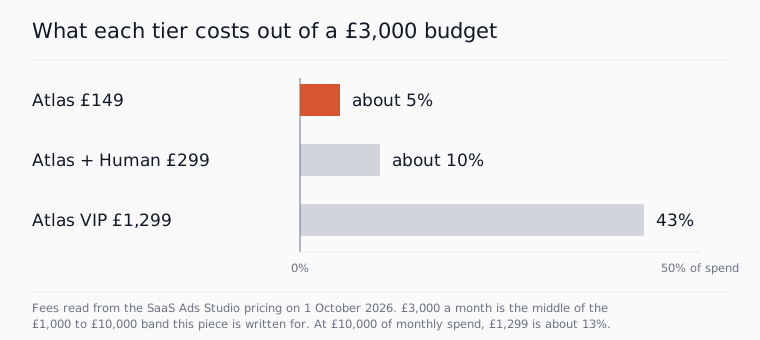
None of which makes the top bar wrong. If you want hands-on work and a monthly strategy call, that is what VIP is for, and at £10,000 of monthly spend the same £1,299 is about 13 per cent. Where an agency retainer lands is a separate question, and we collected the fees agencies actually publish in our piece on what a SaaS PPC agency costs. The point is to choose the share of spend you will hand to management first, then shop inside it.

Where Atlas sits between the two
Atlas is an operator rather than a co-pilot, and the difference is the product: co-pilots suggest, operators do. Atlas connects to your own Google Ads account, builds the campaigns in hours, and then runs Google week to week at the approval tier you choose, Full Manual, Smart Auto or Full Auto, all inside hard limits. It never blocks a converting search term, it will not add more than 30 negative keywords or 5 broad match keywords in a day, campaigns are always created paused, and anything it does can be undone within 30 days. You set the boundaries, it does the week.
Two limits are worth saying out loud. Google and Meta are not symmetrical here: on Meta, Atlas builds the campaigns and ships weekly tools you run yourself in a few minutes, with no Meta Marketing API integration, so nothing is applied for you on that platform, and our Facebook ads for SaaS page covers that side. On the free tier Atlas does not run live ads at all, because that tier is conversion tracking setup and limited use of the tools. If the honest answer for you is that you want a person in the loop, Atlas + Human at £299 a month has a professional ads manager reviewing every Atlas decision, which is the shape of AI ads management for SaaS we actually sell.
How to decide this before Monday
Write down who is going to read the search term report this week, by name. If that is you and you really will, a tool is enough, and the Recommendations tab in your own account is a free place to start. If the honest answer is nobody, stop buying suggestions and buy execution: either an agency at a fee your spend can carry, or an operator that does the week itself. If you are leaving one agency for another, the handover matters more than the pitch, and our guide to switching SaaS PPC agencies has the checklist. If you only want the shortlist, our roundup of SaaS PPC agencies is there too.
Atlas’s free tier sets up conversion tracking and opens the tools with no card, and nothing goes live until you say so: start at app.saasadsstudio.com.
Questions people ask about this
- Can Atlas apply changes to my Meta account automatically?
- No. On Meta, Atlas builds the campaigns and ships weekly tools you run yourself in a few minutes. There is no Meta Marketing API integration, so nothing is applied for you there. The automatic week-to-week management is the Google Ads side only.
- Can I keep my agency and run Atlas alongside it?
- Yes. Atlas connects to your own Google Ads account, so you decide what it touches, and the free tier does not run live ads at all. Plenty of teams start there for conversion tracking while someone else runs the campaigns, then move the ads across later.
- How long does it take to get campaigns live?
- Atlas builds the account in hours rather than weeks, and campaigns are always created paused, so nothing spends until you unpause them. The slow part is usually conversion tracking and agreeing what counts as a lead, which is worth doing properly first.
- Is there a contract or a minimum term?
- There is no minimum commitment. You can cancel any time through the app and it takes effect at the end of that billing period, and fees already paid are not refundable. No tier carries a guarantee of results, and we do not offer one.
- What does the optimisation score in my Google Ads account measure?
- Google describes it as an estimate of how well your account is set to perform, scored from 0 to 100 per cent, and it moves when you apply or dismiss recommendations. Dismissing them raises it too, which is worth knowing before reading it as a grade.
