
Is Your SaaS PPC Agency Working?

The short version
- You can judge a PPC agency well before the full quarter it asked for. By week six the account should show weekly work in its change history, a tested primary conversion and a search terms report someone has read.
- Google Ads does have a learning period, but Google ties its length to how many conversions a campaign gets and how long they take. A campaign with no qualified conversions has nothing to learn from.
- Time on site, clicks and impressions are activity. Qualified trials, booked demos and paying customers are results.
- A request to raise the budget before tracking is proven is the clearest warning sign of the first quarter.
- If you would rather not hire again, Atlas runs Google Ads week to week at the approval tier you set, from £149 a month.
Yes, you can tell whether a PPC agency is working before you have spent a quarter finding out. Not from lead volume, which may still be thin at week five, but from the account itself: what has been changed, what is being measured and what is being excluded. All three are visible today in your own Google Ads login.
In a thread on r/PPC that drew more than a hundred replies in August, the owner of a new B2B consultancy account described week five with an agency: mostly Maximise Clicks search campaigns, about a third of the budget in Performance Max, a few “conversions” and none of them qualified. The agency’s good news was that time on site had gone up. The same shape turns up in SaaS accounts all the time.
What “it is still early” should and should not cover
“Still early” is fair about lead volume and unfair about almost everything else. Google Ads does have a learning period, and Google’s help page on it ties its length to three things: the number of conversions a campaign gets, how long a click takes to become a conversion, and the bid strategy itself (read 6 October 2026). It says calibration typically takes one to two conversion cycles.
That makes “it is learning” a claim you can check. If the campaign uses a conversion-based strategy and records real signups or demos, a few weeks of patience is reasonable, especially where a trial takes a fortnight to turn into anything. If it records nothing qualified, the bidding has nothing to learn from, and more time will not change that.
Maximise Clicks is the clearest case. Google describes it as a strategy that sets your bids to help get as many clicks as possible within your budget (read 6 October 2026). That is a fine way to buy early data for a few weeks, but it is not learning to find demos, because demos are not what it has been told to find. If your account runs on it at week five and the update says “learning”, ask what exactly is being learned.

What should have changed in the account by week six
By week six, the change history should read like someone has worked in the account every week. Google’s change history lists the changes made to your account, campaigns and ad groups over the past two years, shows the email address of whoever made each change in the interface, and lines those changes up against clicks, conversions and cost (read 6 October 2026). It is the most honest report you will get, and the agency does not write it.
Open it from the Campaigns menu and look at the last four weeks. Real work in a young SaaS account tends to look like this:
- Negative keywords added in batches, most weeks, after someone read the search terms report.
- Keywords paused or added for reasons you can trace back to those search terms.
- Ads rewritten once there is data, rather than left exactly as launched.
- Conversion actions edited once, early, so the primary one is a real signup, trial or demo request.
What does not count is a history made almost entirely of budget edits, or a bid strategy that keeps being swapped. Google lists a new strategy and a changed setting among the reasons a bid strategy goes back into “Learning”, so constant switching resets the very clock you are being asked to wait for.
A fair timeline for the first twelve weeks
A good agency can tell you in advance what each stretch of the first quarter is for. Weeks one and two are for setup: conversion tracking tested against a real signup or demo, brand and core non-brand search live, and the first search terms read. Weeks three to six are for cleaning up: negatives added most weeks, ads rewritten from real data, and either the first qualified conversions or a written reason why not.
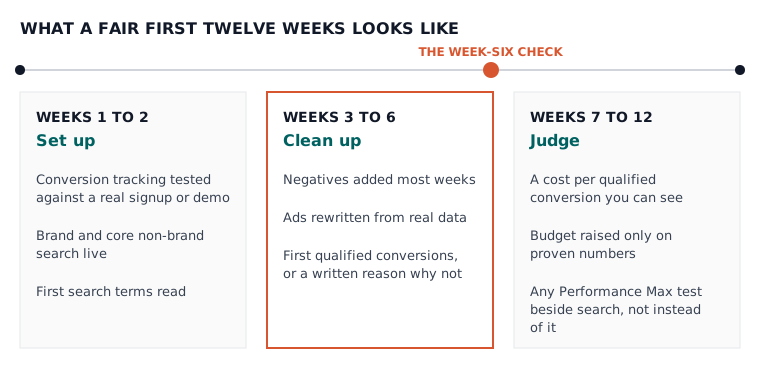
Weeks seven to twelve are for judging: a cost per qualified conversion you can see, the budget raised only on proven numbers, and any Performance Max test running beside search rather than instead of it. Week six is late enough for the clean-up to be visible and early enough that you have not paid for a quarter of guessing.
Activity numbers are not results
Impressions, clicks, click-through rate and time on site tell you the ads are running, not that they are working. The line that matters is the conversion: a trial someone actually starts, a demo a real buyer books, and further down, a customer who pays.
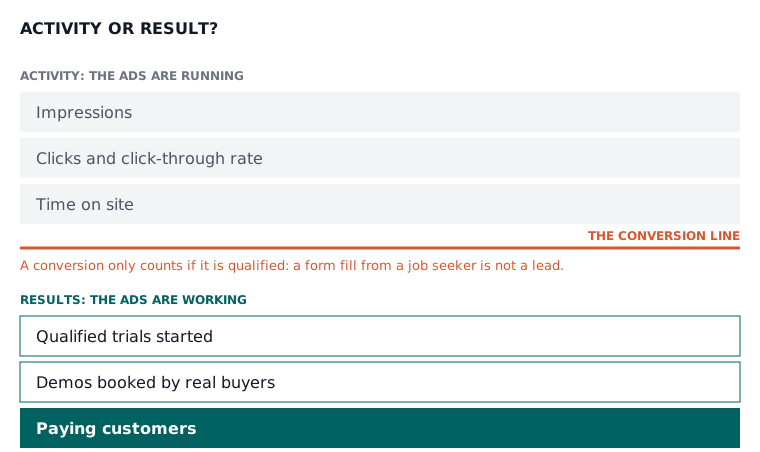
The conversion also has to be the right one. A form fill from a student or a job seeker counts in Google Ads exactly like a demo request from a head of finance. So “a few conversions, none qualified” at week five is not neutral: it usually means the primary conversion action is too loose or the search terms too broad, and both can be fixed this week. Our free search term analyser shows you the second from an export of your own report, and the conversion tracking planner helps you write down what should be firing.

When the agency asks for more budget
A request to raise spend is reasonable once three things are true, and a warning sign before that. The primary conversion fires on a real signup, trial or demo, and someone has tested it. The search terms report has been read and the obvious waste excluded. And there are qualified conversions to scale, even a handful. Without them, more budget buys more of whatever the account is already buying.
The size of the step matters too. In the accounts we run, we never more than double an account inside a month: grow it faster and the bidding is relearning while you lose any way of saying which change did what. We default to phrase match, keep exact match for brand terms, and treat Performance Max as an experiment alongside search that already converts, never a third of an opening budget. Until search is producing qualified conversions, Performance Max has nothing to learn from either.
Questions to put to the agency this week
These are about the account rather than the monthly report, and a good agency answers all of them on one call without opening a slide deck.
- Which conversion action is primary, and how did you test that it fires on a real signup or demo?
- What did you exclude from the search terms report in the last 30 days, and why?
- Can you walk me through the change history for the last four weeks?
- What result would make you recommend cutting spend rather than raising it?
- What will be different in the account by week twelve, and how will we both know?
If the answers are vague, look at the fee next: we set out what a SaaS PPC agency costs and when you do not need one.

When to give it more time and when to leave
Give it more time if the change history shows weekly work, the conversion tracking has been tested, and there is at least a trickle of qualified signups or demos at a cost you can see. Low volume at week six is normal on a modest budget; you are judging direction. Agree a date, ideally week twelve, and the number you will judge it on, in writing.
Start planning an exit if the history is thin, the update leans on time on site, and the next step on offer is more budget. Before you send any notice, make sure you hold admin access and the billing; our guide to switching SaaS PPC agencies covers the order to do it in. And if the honest answer is that you needed someone acting on the account each week rather than advising on it, read what agencies do that software cannot before you hire again.
Where Atlas fits if you would rather not hire again
Atlas sits between another retainer and doing it yourself. It connects to your own Google Ads account, builds the campaigns, then runs the weekly work on search terms, negatives, ads and budgets at the approval tier you choose: Manual, Smart or Full Auto. Every change passes rule-based safety rails before it can touch the account, a change that does not clear them is held for your review, and you can undo any Google change within 30 days.
Atlas works through the access you grant it via the Google Ads API, so its changes sit in your own change history like anyone else’s, each with the reason written in plain English. Atlas is £149 a month, or £299 a month for Atlas + Human, where a professional ads manager from our team reviews every Atlas decision and approves, adjusts or corrects it. There is more on Google Ads for SaaS and on what an AI ads manager does each week.
Judge the account, not the update
The update tells you what the agency wants you to notice; the account tells you what happened. Spend twenty minutes this week in the change history and the search terms report, ask the five questions, and agree the week-twelve number in writing.
Most agencies pass that test, and the ones that do have earned your patience. The ones that would rather talk about time on site have already told you what you needed to know.
To look at your own account first, start on the free Atlas plan and set up conversion tracking properly before the next agency call.
Questions people ask about this
- Why does my search terms report not show every search that triggered my ads?
- Google leaves out some search terms that do not have enough query activity, to keep to its data privacy standards. Its search terms insights group those low-volume queries into themes instead, without showing the queries themselves. So a short report is not proof that nothing irrelevant is spending your budget.
- Will changes made by software show up in my change history?
- Usually, yes. Google says changes made through the Google Ads API, for example by a third-party tool, may show as Google Ads API or the tool's own name in the User column. Some automated changes appear under names such as Google Ads system, which Google says are typically maintenance and usually do not alter live settings.
- Does Atlas manage Meta ads the same way as Google Ads?
- No. On Google Ads, Atlas runs the account week to week at the approval tier you set. On Meta, Atlas builds the campaigns and gives you weekly tools you run yourself in a few minutes. There is no Meta Marketing API integration, so nothing is applied to a Meta account for you.
- Is there a minimum term on Atlas?
- No. You can cancel at any time through the app, and cancellation takes effect at the end of your current billing period. Fees are non-refundable, and your account data is kept for three months afterwards in case you come back. No tier carries a guarantee of results.
- Does Atlas run my ads on the free plan?
- No. The free plan is self-serve: full conversion tracking setup for Google and Facebook, limited use of the other eight Atlas tools, and email support. Atlas does not run live ads on it. Having Atlas run your Google Ads starts on the £149 a month plan.
