
Why Your Non-Brand CPA Keeps Climbing

A non-brand CPA that climbs while nobody touched the account has almost always moved for one of two reasons: each click costs more, or fewer clicks turn into signups and demos. Cost per acquisition is cost per click divided by conversion rate, so find out which half moved before you change anything. The usual causes after that are few: conversions not counted yet, a busier auction, broad match reaching new searches, a recommendation Google applied for you, or a landing page someone else edited. Each one leaves a trace in your own account.
A B2B owner put it plainly on r/googleads: their cost per acquisition was no longer what it had been, and nothing had changed on their side. Split the number in two and it is rarely a mystery.
Split your CPA into its two halves first
Before you look for a cause, work out whether clicks got dearer or conversions got scarcer, because the fixes have nothing in common. Pull cost per click and conversion rate for non-brand campaigns over the last 30 days and the 30 before, with brand left out, since cheap brand conversions hide whatever non-brand is doing.
Take some made-up round numbers, not anyone’s real account. At £4 a click and a 5% conversion rate, your CPA is £80. If clicks rise to £5 and conversion rate holds, CPA is £100. If clicks stay at £4 and conversion rate falls to 4%, CPA is also £100. Same number on the dashboard, two different problems.
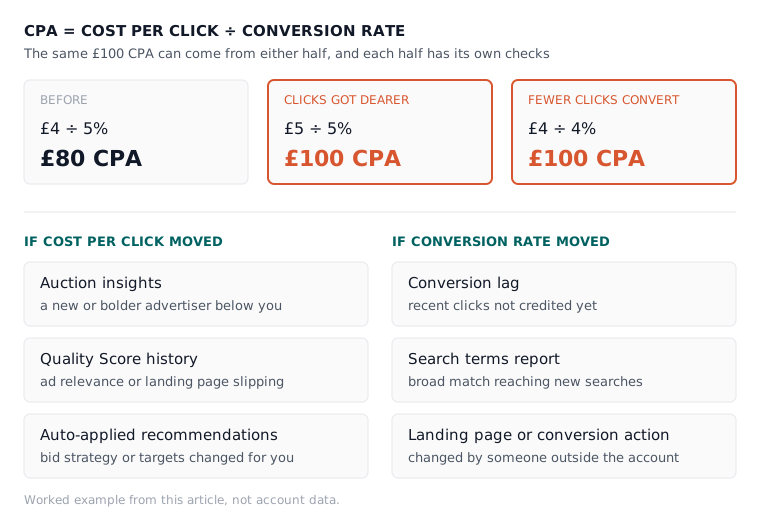
If both halves moved, start with conversion rate. In the accounts we run, a falling conversion rate usually means the account is buying different searches, and that is the cheaper problem to fix.
Rule out the conversions that have not arrived yet
The most recent fortnight of a SaaS account often looks worse than it is, because Google files a conversion against the day of the click, not the day it happened. Google’s page on conversion columns gives the example (read 24 October 2026): an ad clicked last week that converts this week is reported back to last week in the main columns. The same page says reporting can lag by 24 to 48 hours.
Where trials or demos come days after the first visit, last week’s CPA will keep falling as its conversions land. Compare complete periods, and add the Conversions (by conv. time) column to see what happened on each date. In the accounts we run, the last seven days never go into a trend anyone acts on.
Check the conversion action too. If someone made a stricter action primary, or a tag stopped firing after a site release, CPA will move with no change in the ads at all. Our free conversion tracking planner helps you write down what should fire, so you can test it.

If cost per click rose, look at the auction
A higher cost per click with no change to your bids usually means someone else in the auction changed theirs. Google’s definition of actual CPC says you pay only what is needed to clear the Ad Rank thresholds and beat the advertiser immediately below you, and that the competitiveness of the auction affects what you pay (read 24 October 2026). A new rival bidding on your category terms raises your price without you touching a thing.
The auction insights report is where to check. Google says the report shows six statistics for Search campaigns, including impression share, overlap rate and outranking share, and shows nothing when your impression share is below 10% (read 24 October 2026). Run it for your non-brand campaigns over the two periods you compared, and look for a name that is new or whose overlap rate jumped.
What you do next is a budget call, not a bidding war. Some category terms are worth the new price because they bring demos; others only ever brought signups that went nowhere. Trim the second group before you raise a single bid.
If conversion rate fell, read the search terms
A falling conversion rate on unchanged keywords usually means those keywords now match different searches. Google’s page on keyword matching options says broad match may take into account the searcher’s recent search activity, the content of your landing pages and the other keywords in the ad group (read 24 October 2026). So the searches a broad keyword reaches can shift from week to week while your keyword list stays identical.
The search terms report is the only place this shows. Sort the last 30 days by cost and look for terms with spend and no conversions: job seekers, students, people after a free template, a rival’s login page. Our free search term analyser sorts an export of your own report into what to keep and what to exclude.
Keyword length is a useful tell. In our keyword length study of 12,589 non-brand keywords, £1,998,000 of ad spend and 15,000+ conversions across 14 SaaS accounts, with brand terms excluded, three-word keywords converted cheapest at £124. One-word keywords averaged £135 and five-plus words £136, with two words at £132 and four at £130.
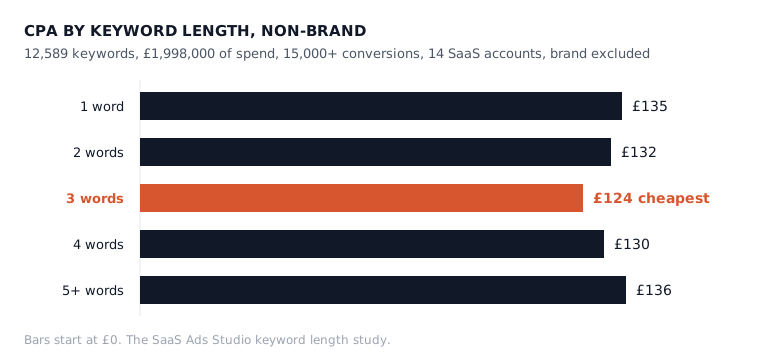
That is why we run phrase match by default and keep exact match for brand terms. The same Google page says phrase match shows ads on searches that include the meaning of your keyword, reaching more searches than exact and fewer than broad. Broad match earns a place once a campaign has conversion data to learn from, and even then someone needs to read its search terms every week.

Check who else changed the account
“Nothing changed on my side” is often true and still beside the point, because Google, an agency or a colleague may have changed it for you. If auto-apply is switched on, Google’s page on applying recommendations automatically says the chosen recommendations apply regularly, and the bidding ones on its list include adjusting your CPA targets and switching to Maximise clicks (read 24 October 2026). Either can move CPA on its own.
The same page points to the History tab on the Recommendations page and to change history for each individual change. Open change history for the weeks before the rise and read every line, including the ones you did not make.
Look outside the account as well. A landing page redesign, a new pricing page or a longer signup form can cut conversion rate overnight, and whoever shipped it may not know it touched your ads. Ask the product team what went live that week.
If quality slipped, one page change costs you twice
Ad quality feeds the price you pay, so a worse landing page can raise cost per click and cut conversion rate at the same time. Google’s actual CPC page lists expected click-through rate, ad relevance and landing page experience among the things it combines into Ad Rank. When those slip, you pay more to hold the same place.
You can see whether that happened. Google’s Quality Score page describes historical columns such as Quality Score (hist.) and Landing Page Exper. (hist.), and says you can segment the keyword table by day to watch the scores change (read 24 October 2026). It also says changing match types will not affect Quality Score, so a drop points at the ad or the page rather than your keyword settings.

Fix one thing a week and keep the scale steady
Once you know which half moved and why, change one lever a week. Changing the bid target, the match types and the budget in the same week leaves you with a new CPA and no idea which change caused it. In the accounts we run, the weekly checks never vary: the search terms report, new negatives, auction insights for the main non-brand campaigns, and the change history.
Avoid the two panic moves. One is slashing the CPA target, which in our experience starves the campaign of volume while it adjusts. The other is pouring in budget to push through: we never more than double an account inside a month, because the bidding needs time to settle and you lose the ability to say what worked. A climbing CPA is a diagnosis first and a spending decision second.
Where Atlas fits
Atlas runs this weekly work on your Google Ads account, inside limits you set. Every week it reviews search terms, updates negatives, sweeps broad match performance, paces budgets and flags waste, at the approval tier you choose: Manual, where every change waits for your sign-off, Smart, where only low-risk changes such as negatives apply without you, or Full Auto.
Every change passes rule-based safety rails first, anything that fails them is held for your review, and you can undo any Google change within 30 days, with the reason for each written in plain English. Atlas is £149 a month, or £299 a month for Atlas + Human, where a professional ads manager from our team reviews every Atlas decision. There is more on Google Ads for SaaS and on what an AI ads manager does each week.
Find the half that moved
Check the conversions are complete, then ask whether clicks got dearer or fewer of them converted, and follow that half to the auction, the search terms, the change history or the landing page. Most of the time the cause is already sitting in a report you have, and the fix is one lever, pulled once, then left alone for a fortnight.
If someone else runs the account, take this list to them and read how to tell whether your SaaS PPC agency is working. If you run it yourself, start by getting the measurement right: conversion tracking setup is free on the Atlas free plan, though Atlas does not run live ads on it.
Questions people ask about this
- Should brand and non-brand keywords sit in separate campaigns?
- Yes. Brand searches convert cheaply because the searcher already knows you, so mixing them in hides a rising non-brand CPA behind a blended average. We keep brand in its own campaign on exact match with its own budget, and judge non-brand on its own cost per qualified signup or demo.
- How long should I wait after a change before judging CPA?
- Google says frequent manual changes to budgets, CPA or ROAS targets or conversion goals reset the standard 7 to 14 day learning period. So give a bidding change at least two weeks, longer if your trials or demos take days to convert, and avoid stacking a second change inside that window.
- Is a higher CPA always a bad sign?
- No. If you changed your primary conversion from any signup to an activated trial or a booked demo, CPA should rise, because you are counting fewer, better conversions. Judge that move on cost per paying customer from your CRM. A higher CPA with more customers behind it is progress, not a problem.
- Can Atlas fix a rising CPA on the free plan?
- No. The free plan is self-serve: full conversion tracking setup for Google and Facebook, limited use of the other 8 Atlas tools, and email support. Atlas does not run live ads on it. Weekly changes to a live Google Ads account start on the Atlas plan at £149 a month.
- Does Atlas manage Meta ads the same way as Google Ads?
- No. On Google Ads, Atlas applies weekly changes at the approval tier you set. On Meta, Atlas builds the campaigns and gives you weekly tools you run yourself in a few minutes, such as creative fatigue checks, audience health and budget pacing. Nothing is applied to a Meta account for you.
