
Optmyzr vs WordStream vs Opteo

Optmyzr, WordStream and Opteo turn up on the same shortlist constantly, and they are not three versions of one product. All three sites were read today, 29 September 2026. Optmyzr is a broad optimisation and reporting suite whose price is set by how much you spend on ads. Opteo is Google Ads software with a published rate card and an accept-or-dismiss workflow. WordStream is not something you can subscribe to at all: there is no pricing page in its navigation, and its Solutions menu ends at a demo request.
We make one of the four tools below, so read it with that in mind. Atlas is ours and it goes first, which is more honest than burying it at number three. Top here means notable, the handful a lean B2B SaaS team actually weighs up, not a ranking of quality. Every fact about the other three was read off that company’s own website today and dated in the text, and we link to none of them.
The short version
The deciding question is not which tool has the longest feature list. It is who applies the change once the software has worked out what the change should be.
- Atlas, by The SaaS Ads Studio: for a B2B SaaS team that wants Google Ads built and then run for them, at an approval tier they set.
- Optmyzr: for an in-house marketer or agency wanting breadth across platforms and reporting, with hours each week to drive it.
- Opteo: for someone who wants specific Google Ads recommendations to review themselves, from a company that publishes its rate card.
- WordStream: for a free account grade and free keyword research, not for ongoing management, because there is nothing self-serve left to buy.
Two of the four are software you operate, one is a free diagnostic attached to a managed service, and one runs the account. The directory pages that rank for these searches tend to flatten that distinction, which is how people end up comparing a grader with a rule engine.
Atlas, by The SaaS Ads Studio
Atlas is an AI ads manager for B2B SaaS, trained on £10M of real SaaS ad spend. It connects to your own Google Ads account, builds the campaigns in hours rather than weeks, then works the account week after week at the approval tier you choose. It is not a chatbot pointed at an account and not an agency retainer, and the way we put it on a first call is that it is not DIY, it is not an agency, it is the sensible middle ground. What that covers in practice is set out on our Google Ads for SaaS page.
The tiers, read from the site’s own constants today, are Free at £0, Atlas at £149 a month, Atlas + Human at £299 a month and Atlas VIP at £1,299 a month. The free tier covers conversion tracking setup and limited use of the tools, and Atlas does not run live ads there. Atlas + Human puts a professional ads manager over every decision, and VIP adds a monthly strategy call and hands-on work. There is no minimum commitment.
Google and Meta are not symmetrical here, and pretending otherwise would be the easiest lie in this category to tell. On Google, Atlas manages the account and applies weekly changes at your tier. On Meta it builds the campaigns and then ships weekly tools you run yourself in a few minutes, because there is no Meta Marketing API integration behind it.
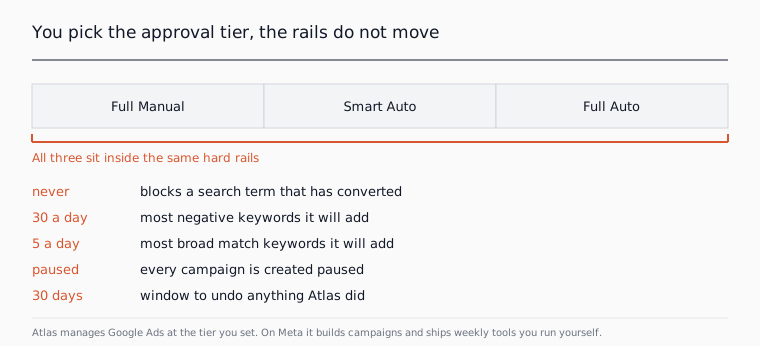
The rails are fixed whichever tier you pick: Atlas never blocks a search term that has converted, adds at most 30 negative keywords and 5 broad match keywords a day, creates every campaign paused, and anything it did can be undone within 30 days.
Why They’re a Good Choice
- Atlas builds and runs the account rather than handing you a list to action later. An operator does the work; a co-pilot suggests it.
- Every capability is paired with a control: you set the tier, you approve what you want to approve, you can undo it.
- The price is on the page, monthly, with no minimum commitment and no six week onboarding project first.
- You can start free, get conversion tracking straight, and decide about live campaigns once you can see your own numbers.

Optmyzr
Optmyzr is the broadest of the three: an optimisation, insight and reporting suite for paid search, with Meta and LinkedIn account connections alongside it. Its pricing page, read today, sells Essentials, Premium and Enterprise, and prints no monthly figure at all. You set your monthly ad spend on a selector running from 25K to 500K and over, choose monthly or annual billing, and the number follows from that.
What sits in each plan is worth knowing before buying the cheapest. Essentials carries what the page calls the core toolkit, while Premium and Enterprise carry the complete one. Shopping and Performance Max retail campaign and feed management is listed as not included on Essentials. Rule Engine automations run weekly or monthly there, daily on Premium, hourly on Enterprise on request. Email support is a 24 hour turnaround on Essentials and four hours at the top.
The honest limitation is the one that applies to any suite: it is a tool for an operator, not an operator. The audits, bidding tools and budget pacing all sit there ready, and somebody still has to open it and push the changes. Spend-based pricing also means you cannot work out your own cost without telling it your numbers, which makes budgeting a conversation. We put what this category charges side by side in what these tools actually cost.
Why They’re a Good Choice
- Real breadth in one place: search queries, bidding, account audits, budget pacing, alerts, dashboards and white-labelled reports.
- The Rule Engine, plus pre-built, custom and AI-generated Blueprints, which is why agencies stay with it for years.
- Meta and LinkedIn accounts connect alongside search, with single-account social tools and a social rule engine.
- A trial with no credit card required, and platform migration support shown on every plan. Our Atlas and Optmyzr write-up has the side by side.
Opteo
Opteo is the easiest of the three to evaluate, because it says what it does and what it costs before you sign anything. It is Google Ads software from a London company, Opteo Ltd of 42-46 Princelet Street, company number 08590289, read from its own pricing page today. It watches the account and produces specific improvements to accept or dismiss: keywords, ad creative, bids, excluding bad traffic, detecting errors, shopping, budgets, reports, alerts and a Slack integration.
Its published card has four tiers, Basic, Professional, Agency and a custom Enterprise, and each is defined by a number of connected accounts and a monthly ad spend ceiling. Basic covers 10 accounts and $25,000 of spend a month, Professional 25 accounts and $100,000, Agency 75 accounts and $250,000, those limits stated in US dollars on the page. The data refresh cycle tightens as you climb, from 24 hours on Basic to six on Enterprise.
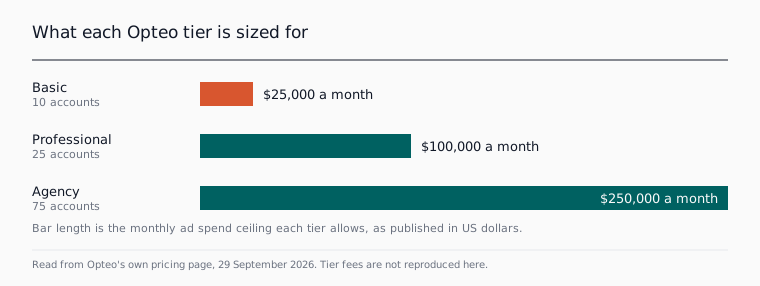
That shape is what matters if you are one SaaS company with one account, because the entry tier is built for somebody managing ten of them. Opteo is Google Ads only, so Meta and LinkedIn sit outside it, and as with any recommendation engine the reviewing and the applying are still your Tuesday morning.
Why They’re a Good Choice
- A rate card you can read before committing, which a good part of this category does not offer.
- One improvement at a time with the reasoning shown, which teaches you the account rather than just changing it.
- Google Ads Reports on every published tier, plus alerts into Slack.
- Changes appear in your Google Ads change history under your manager account email, so nothing is hidden from a colleague. Our Atlas and Opteo write-up covers the overlap.

WordStream
WordStream is the one people are most often surprised by, because it is not management software you can buy any more. Read today, its top-level navigation is Blog, Free Tools, Resources, Solutions and About Us, with no pricing page in it. The Solutions menu offers For Businesses and For Agencies, and both end at a demo request. The legal pages in the footer point to LocaliQ and the copyright line reads USA TODAY Co, Inc.
What it does offer is useful and free. The homepage leads on the Google Ads Performance Grader, an instant audit which the page says scores nine key areas, and it lists eight of them: wasted spend, Quality Score, click-through rate, impression share, best practices, account activity, long-tail keywords and mobile optimisation. Around it sit a Facebook ads grader, a free keyword tool with volume and cost-per-click data, a return on ad spend calculator and a website grader.
The limitation is that it answers a different question from the other two. If you came wanting software to run the account week to week, there is nothing to subscribe to: you get a one-off grade, some free tools and a conversation about a managed service. That is a fair offer, and it is worth knowing which offer it is before you spend an afternoon hunting for the plans page.
Why They’re a Good Choice
- The grader gives you a read on wasted spend without a contract, a card or a call.
- The free keyword tool returns volume and cost-per-click figures, which is more than most free tools manage.
- The blog and guides are a decent free education if nobody on the team has run paid search before.
- Nothing to cancel afterwards. Our Atlas and WordStream write-up sets out what we do instead.

How to choose if you run one small SaaS account
Ask who applies the change, not who spots it. When nobody on the team does paid search daily, the software that finds the problem is the cheap part. Optmyzr and Opteo both hand you better decisions and leave the doing with you, and Atlas does the doing and shows you what it did.
Then ask what you can find out before you pay. Opteo publishes a card, Optmyzr prices from your spend so you have to ask, and WordStream has nothing to price because there is nothing to buy. None of that is a character judgement, but it does change how long the decision takes, and a founder with one spare afternoon is entitled to weigh it.
Last, ask whether the tool fixes what you are short of. On accounts spending £1,000 to £10,000 a month, teams are rarely short of insight; they are short of the hour it takes to read the search term report and act on it. That is the hour where broad match quietly bleeds budget, which is why our own weekly rhythm is fixed: read the search terms, phrase match by default and exact for brand, never more than double an account inside a month. Our free search term analyser does the reading part, and the wider software round-up covers options beyond these three.
What we would tell a founder on a first call
If you have somebody who enjoys paid search and genuinely has hours for it, Optmyzr rewards that person more than anything else here, especially across several accounts. If you want to read a price, get clear recommendations and stay in control of every change, Opteo is the unfussy choice, and being Google Ads only is no great loss for most SaaS teams. If you just want a free read on wasted spend, take WordStream’s grader and ignore the rest of the funnel until you are ready for it.
If the real problem is that nobody has the hour, that is the gap Atlas was built for. It builds the campaigns and applies weekly changes on Google at the tier you set, and on Meta it builds and hands you weekly tools to run yourself. You set the boundaries, you approve what matters to you, and anything can be undone. Start free at app.saasadsstudio.com, get your conversion tracking right, and decide about live campaigns when you can see your own numbers.
Questions people ask about this
- Do any of these three manage Meta ads as well as Google Ads?
- Optmyzr's pricing page lists Meta and LinkedIn account connections and social campaign tools, read on 29 September 2026. Opteo's site covers Google Ads only. WordStream publishes a free Facebook ads grader. Atlas builds Meta campaigns and ships weekly tools you run yourself, and applies nothing on Meta for you.
- Can I try Optmyzr or Opteo before paying anything?
- Both publish a trial on their own sites, read on 29 September 2026. Optmyzr's pricing page carries a start trial button and states that no credit card is required. Opteo offers a free trial on each published tier. Atlas has a free tier at no cost, where it does not run live ads.
- Will my team see that a tool made a change in the account?
- Yes, in the Google Ads change history. Opteo's own FAQ, read on 29 September 2026, says changes made through it appear there under the email attached to your manager account, and that clients are not notified separately. Atlas changes show up the same way and can be undone within 30 days.
- What happens if I want to stop paying?
- Atlas has no minimum commitment: cancel in the app any time and it ends at the close of your billing period, and fees already paid are not refunded. Opteo's own FAQ, read on 29 September 2026, says it will refund your most recent invoice if you are dissatisfied with it.
- Do these tools work with a Google Ads manager account?
- Opteo's FAQ, read on 29 September 2026, says you can connect any combination of manager accounts and single accounts, and that your connected spend is added up to decide your tier. Optmyzr lists additional connected accounts as a paid add-on on its Premium plan. Atlas connects to the one account you choose.
