
What Google Ads Tools Actually Cost

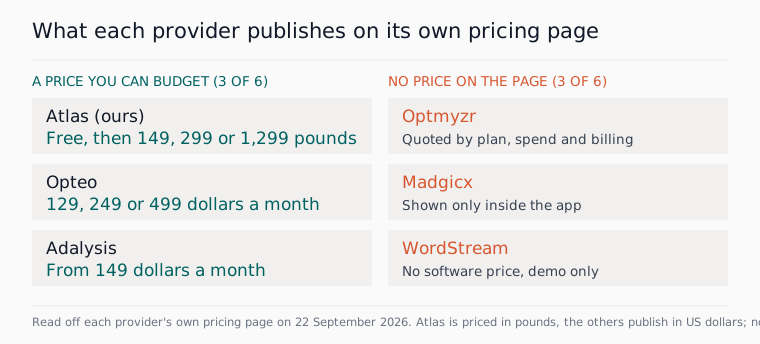
Six providers, and only three of them will tell you what they charge. Every figure on this page was read off each provider’s own pricing page on 22 September 2026, and where a page publishes no number we say so rather than repeat one from a review site, because a stale price quoted confidently is worse than an honest gap.
We make one of the six, Atlas, so it goes first because it is ours and not because a panel scored it, and “top” here means notable rather than ranked by quality. We do not link to any of the other five, and Atlas is priced in pounds while the rest publish in US dollars, so each figure stays in the currency its own page uses instead of being converted at a rate that is wrong a month later.
The short version
- Atlas, ours: free, then £149, £299 or £1,299 a month. For a SaaS team that wants Google Ads built and then run week to week.
- Optmyzr: priced on the page by plan, ad spend bracket and billing period. For teams who already pay someone to work inside a tool.
- Opteo: $129, $249 and $499 a month, published in full. For one Google Ads account under $25,000 of monthly spend.
- Adalysis: from $149 a month on a single plan. For auditing and ad testing across Google and Microsoft Ads.
- Madgicx: one plan, priced once you are inside the app. For Meta-led ecommerce advertisers.
- WordStream: free graders, no published software price. For an outside opinion before you buy anything.
Atlas: free, £149, £299 or £1,299 a month
Here is the whole rate card, since we are asking everyone else for theirs. The free tier is £0 and covers conversion tracking setup and limited use of the tools, and Atlas does not run live ads on it. Atlas at £149 a month connects to your own Google Ads account, builds the campaigns and then applies weekly improvements at the approval tier you choose. Atlas + Human at £299 puts a professional ads manager over every decision Atlas makes, and Atlas VIP at £1,299 adds a monthly strategy call and hands-on work in the account.
Google and Meta are not the same job here, and pretending otherwise would be the easiest lie in this article. On Google, Atlas operates the account week after week. On Meta, Atlas builds the campaigns and ships weekly tools that you run yourself in a few minutes.
Every capability comes with a control, because that is the only way an operator belongs near a live account. Campaigns are always created paused, approval tiers run from Full Manual through Smart Auto to Full Auto inside hard rails, and anything Atlas does can be undone within 30 days.
Why They’re a Good Choice
- Atlas is trained on £10M of real SaaS ad spend, so the keyword, ad copy and search term work starts from how SaaS buyers actually search.
- The safety rails are specific rather than reassuring: never blocks a converting search term, at most 30 negative keywords a day, at most 5 broad match keywords a day.
- Rob Walling of MicroConf put it as “think of it as an agency team in a box”, which is the comparison we would rather be judged on.
- The honest limitation: under about £1,000 a month of spend there is not enough weekly data to decide anything, and Atlas is built for B2B SaaS rather than ecommerce.
Optmyzr: a configurator, not a rate card
Optmyzr asks what you spend before it shows you a number. Read on 22 September 2026, its pricing page offers Essentials, Premium and Enterprise, a monthly or annual toggle, and an ad spend selector running from $25K to $500K+, and what you pay depends on all three. Enterprise is a custom plan behind a contact form, and the page carried a pre-Black-Friday offer of 45 per cent off an annual subscription for sign-ups by 30 September.
The plan differences are published even where the prices are not. Shopping and Performance Max feed management is not included in Essentials at all. Rule engine automations run weekly or monthly on Essentials, daily on Premium and hourly on Enterprise on request, and setup help costs $199 an hour on Essentials with one hour included on Premium and four on Enterprise.
For a lean SaaS team the shape matters more than the number: this is a deep toolbox for someone whose job is to be in a toolbox, built for people running many accounts at once.
Why They’re a Good Choice
- Meta and LinkedIn ad accounts connect alongside Google at every tier, which is rare in this category.
- The trial needs no credit card, so you can see the real quote for your spend bracket before committing.
- The comparison table is unusually honest about what the entry tier leaves out, which saves an awkward month.
- The honest limitation: it recommends and automates, and someone still has to sit in it. If nobody on your team owns that hour, the subscription is the cheap part.

Opteo: $129, $249 or $499 a month
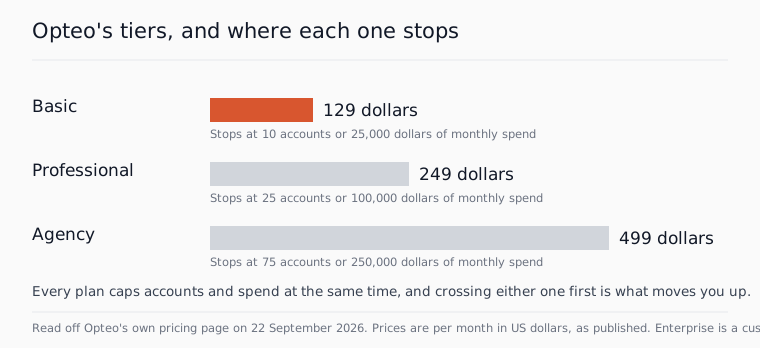
Opteo publishes the cleanest rate card in this set, so you can budget from the page in a minute. Basic is $129 a month for up to 10 accounts, up to $25,000 of monthly spend, live chat support and a 24-hour data refresh. Professional is $249 for 25 accounts and $100,000 of spend with priority support and a 12-hour refresh. Agency is $499 for 75 accounts and $250,000 of spend, and Enterprise is a custom quote with an account manager and a 6-hour refresh.
The mechanic worth understanding is that every plan caps two things at once. Spend is counted across all the accounts you connect, so two accounts at $10,000 each count as $20,000, and you move up when you cross either cap. Annual billing carries a two-month discount, and the company is a London outfit that will refund your most recent invoice if you are not happy.
Why They’re a Good Choice
- One published price, one page, no configurator and no sales call.
- The recommendations arrive with the numbers behind them, so a junior learns the account rather than just clicking.
- Basic is genuinely sized for a single SaaS account in the £1,000 to £10,000 a month band.
- The honest limitation: Google Ads only, suggestion-led, so the work happens when you sit down and apply it. We keep Atlas next to Opteo if you want that comparison.
Adalysis: from $149 a month on one plan
Adalysis sells one plan and prices it by your maximum monthly ad spend, from $149 a month upwards. There are no feature tiers to decode: every plan carries all features, unlimited Google Ads and Microsoft Ads accounts and unlimited users. What changes as you climb is support, from one onboarding session and a 12-hour email response at the bottom to three sessions, a two-hour response and a dedicated account manager at the top.
The billing detail is refreshingly plain. You pick monthly, six months at 10 per cent off, or a year at 15 per cent off, and the subscription moves itself up or down as your spend crosses a threshold. Cancellation is any time and you pay only for the month in progress.
The product is auditing and testing first: more than 100 audit checks, custom alerts, budget pacing and projections, quality score analysis, search term and n-gram work, and ad testing with statistical significance.
Why They’re a Good Choice
- Unlimited accounts and users at every price point, which agencies and multi-brand teams rarely get.
- Microsoft Ads is treated as a first-class platform rather than an afterthought.
- The spend-tier upgrade comes with four days of written notice rather than a surprise invoice.
- The honest limitation: Google and Microsoft only, and it diagnoses rather than operates. It will tell you what is wrong in forensic detail and leave the fixing to you, as Atlas next to Adalysis sets out.

Madgicx: the price is inside the app
Madgicx sells a single plan, Pro Complete with AI, and its pricing page does not print the price. Read on 22 September 2026, the page asks for your monthly ad spend from brackets running from under $1K through $1K to $2.5K, $2.5K to $5K, $5K to $10K, $10K to $20K, $20K to $30K and $30K+, offers monthly, quarterly or annual billing, then tells you to see the price inside the app. The one figure printed in public is the Tracking Pro add-on at $49 a month for each connected account.
It is also the least Google-shaped product here, and the site says so itself: Madgicx describes itself as the first Ecom Ad Cloud, and its workflows are optimisation, AI ads, analytics and ad management for Meta. There is a 7-day free trial with cancellation any time.
For a B2B SaaS founder pricing Google Ads help, that combination is the problem: the bill grows with your Meta spend, and the number only appears once you have signed up.
Why They’re a Good Choice
- One plan, so there is no feature matrix to decode once you are in.
- The add-on price is published, which is more than the main plan manages.
- Quarterly and annual billing carry the same discount percentages as the main plan, add-on included.
- The honest limitation: Meta and ecommerce first, and a price you cannot see until you are inside the app cannot go in a budget you have to defend.
WordStream: free graders, no published software price
WordStream is the biggest name here and it no longer sells you software at a price. Read on 22 September 2026, wordstream.com has no pricing page anywhere in its navigation: the menu is Blog, Free Tools, Resources, Solutions and About Us, and the two buttons are a free Google Ads grader and a demo request. The commercial route runs through Solutions and a free assessment into LocaliQ’s marketing services, and the footer carries a USA TODAY Co copyright with the legal pages hosted on localiq.com.
The free tools are the reason to visit, and they are properly free. The Google Ads Performance Grader scores nine areas in about a minute, including wasted spend, click-through rate, quality score, impression share and account activity, and a Facebook Ads grader, keyword tool, website grader, viability checker and industry benchmark lookup sit alongside it.
Treat all of that as a second opinion rather than a stack you can price, because there is no self-serve tier to buy.
Why They’re a Good Choice
- The graders cost nothing and need no contract, which makes them a fair sanity check on any account.
- The benchmark and keyword tools are useful before you have account data of your own.
- An outside grade is a cheap way to challenge whoever currently runs your ads.
- The honest limitation: no published price, no self-serve product, and the free tools sit in front of a sales conversation. That is a fair trade as long as you go in knowing it, and Atlas next to WordStream is the software comparison.

What a tool price leaves out
Every figure above buys software, and only one of them buys the work. That is the line that decides your real monthly cost, because a subscription with nobody to drive it is more expensive than one that does the driving, and it is also why an agency retainer sits where it does. We wrote up what an agency charges for the same job if you want that side of it.
The work itself is boring and weekly, which is exactly why it gets skipped. Someone has to read the search term report and add the negatives, check budget pacing, keep phrase match as the default and exact match for brand, and resist doubling a budget inside a month because one week looked good. That is how we run accounts, and it is a rhythm rather than a project.
So price the whole job: the subscription, plus the hour or two a week somebody owes it. Then compare that against how we run Google Ads for SaaS or the wider list of tools in this category. To see what a week of that work looks like first, our free search term analyser runs on your own export.
What we would plan around at £3,000 a month of spend
At that spend, three of the six prices here are directly comparable: Atlas at £149 a month, Opteo Basic at $129 and Adalysis from $149. Optmyzr, Madgicx and WordStream all need a configurator, an app login or a sales call first, which is a reasonable way to sell and an unreasonable way to plan a budget.
If someone on your team wants to run the account and learn it, buy a tool and book the weekly hour. If nobody does, buy an operator instead, and the cheapest honest version of that is Atlas at £149 a month with you approving what it applies. You can start on the free tier at app.saasadsstudio.com, set up conversion tracking properly and see the build before Atlas runs anything live. Every side-by-side we keep sits on the alternatives pages.
Questions people ask about this
- How long are the free trials on these tools?
- Read on 22 September 2026: Adalysis offers a 30-day trial, extendable to 45 or 60 days on its higher support tiers. Madgicx offers 7 days. Optmyzr starts a trial with no credit card required. Opteo offers a trial on every paid plan but does not state the length on its pricing page.
- What happens when my ad spend passes the tier I am on?
- Adalysis adjusts your subscription each month automatically and emails you four days before an upgrade takes effect, and it moves you back down if spend falls. Opteo caps connected accounts and combined spend on every plan, and crossing either one first forces the next tier. Both read 22 September 2026.
- Is annual billing on these tools worth taking?
- Adalysis publishes 10 per cent off six months and 15 per cent off a year. Opteo gives two months free on annual billing. Optmyzr's page carried 45 per cent off an annual subscription for sign-ups by 30 September. All read 22 September 2026. Our advice is to run a tool monthly first, then prepay.
- Does Atlas manage Meta the way it manages Google?
- No, and it matters. On Google Ads, Atlas applies weekly changes at the approval tier you set. On Meta, Atlas builds the campaigns and ships weekly tools you run yourself in a few minutes, because there is no integration that applies Meta changes for you.
- Can I cancel Atlas whenever I want?
- Yes. There is no minimum commitment, you cancel in the app, and cancellation takes effect at the end of the billing period. Fees already paid are not refunded, and your data is kept for three months after you cancel in case you come back.