
Meta Ads or Google Ads First for SaaS

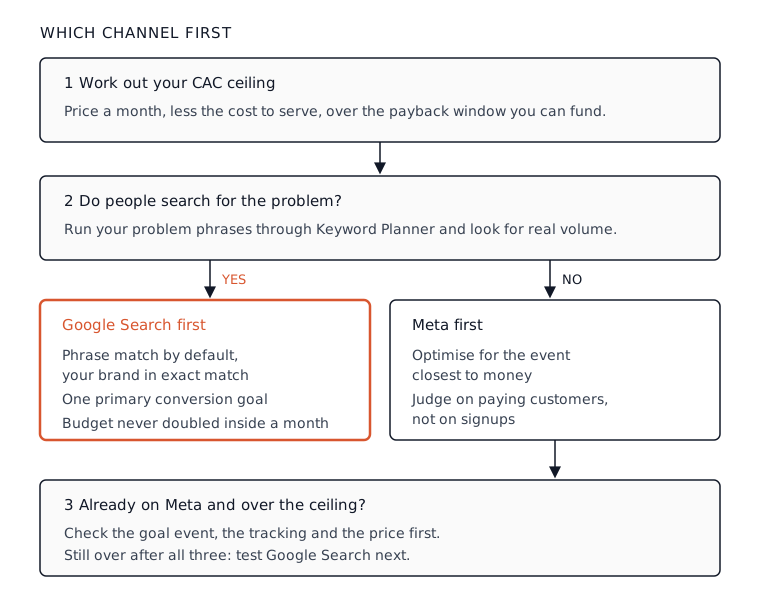
For most B2B SaaS products, Google Search goes first, because it puts you in front of people who are already typing the problem your product solves. Meta goes first only when almost nobody searches for that problem yet, or when the product sells itself in a few seconds to a buyer who was not looking. And if Meta has already found you customers at a cost that does not pay back, the answer is not automatically to switch. It is to work out which of three things went wrong: the maths, the event Meta was told to find, or the channel itself.
A founder on r/googleads put the question plainly: several thousand dollars spent on Meta for a B2B product sold on a monthly plan, customers coming in, a customer acquisition cost (CAC) that did not clear lifetime value (LTV), and no Google Ads account ever opened. A seed-stage team on r/SaaS asked it from the other end: a fixed test budget, small tests already live on both platforms, and no clear view of where the money should go next. This piece answers both with your own numbers rather than anybody’s benchmarks.
Start with the CAC you can afford, not the channel
The channel question cannot be answered until you know the most you can pay for one paying customer. That ceiling comes from three of your own numbers: what a customer pays you a month, what it costs you to serve them, and how many months you can wait to earn the acquisition cost back. Most founders on a monthly plan use a payback window they can fund from cash rather than full lifetime value, because lifetime value on a young product is a guess with a decimal point.
Then compare the ceiling with what you actually paid. Count paying customers, not trials and not signups, against total spend over the same weeks. If the real CAC sits close to the ceiling, you have a channel that needs tuning. If it is several times over, no amount of creative testing closes the gap, and only then is the channel itself in question.
There is a trap here for low-priced products. A product on a small monthly price has a low ceiling, and every channel gets judged harshly against it. Moving from Meta to Google does not raise that ceiling; it changes the kind of buyer you pay for. So be honest about whether the problem is the channel or the price before you spend another month finding out.

When Google Search should come first
Google Search should come first when people already search for the problem you solve, the job your product does or the tool you replace. You pay when someone types those words and clicks, so the ad meets a buyer who arrived with the intent already. That is demand capture, and for a considered B2B purchase it is usually the cheapest paying customer you will ever buy.
You can test for it before spending anything. Google’s Keyword Planner help page, read on the 19th of November 2026, says the tool gives search volume and a forecast of clicks and conversions for a list of keywords, and that keywords with very low search volumes are not discoverable or forecastable at all. If your best problem phrases come back empty, you have learned something for free.
How we run a first Search campaign:
- Non-brand problem and job-to-be-done phrases in phrase match by default, with your brand name in exact match in a campaign of its own (why the two budgets stay apart).
- Conversion tracking on the event that matters, such as a trial that reaches the product’s key action, a demo booked or a paying customer, set as the one primary goal.
- A budget held steady for the first weeks and never more than doubled inside a month.
- The search terms report read every week, with negatives added from what it shows.
Google’s Smart Bidding learning page, read the same day, asks for a single, consistent primary conversion goal and says performance typically settles within one to two conversion cycles. On a product with a two-week trial, that is a month or more of patience, which is why the first 90 days are about clean evidence rather than growth.
When Meta should come first
Meta first makes sense when there is no search demand to capture. A product that creates a new category, or solves a problem people do not yet have words for, finds more buyers through an interruption than through a search box. Meta is demand creation: you put the idea in front of people who were not looking for it, and some of them recognise their own problem in it.
It also suits products whose value shows in seconds. A visual tool, a template library, or a self-serve product that a solo founder can try in five minutes and pay for with a card all convert from a cold scroll, because the gap between seeing and trying is small. Whether you sell product-led or sales-led matters more here than on Google.
What does not suit Meta first is the long, considered purchase: a product sold to a team, with a demo, a security review and someone in finance signing. The person scrolling is rarely the person who signs, and the signal Meta gets back is a signup weeks before any money changes hands. In the B2B accounts we have run, that combination is where Meta CAC looks reasonable on signups and falls apart on paying customers.

What a Meta CAC that fails is telling you
Before you leave Meta, check what you told it to find. In every Meta account we have built, the event you choose as the campaign’s conversion goal is the thing you end up buying more of. If that event is a free signup, you bought free signups, many of them will never pay, and the CAC on paying customers comes out several times higher than the dashboard suggested.
Three checks, in this order. First, the goal event: a signup is cheap and plentiful, while a trial that reaches the key action is closer to money, and moving the goal one step down the funnel often costs volume and saves the business. Second, the counting: duplicate browser and server events, or a thank-you page that fires on every refresh, inflate results on both platforms. Our free conversion tracking planner maps which events to send to Google and Meta and which one to make primary. Third, the price: if customers arrive and churn in month two, neither channel fixes that.
If all three are clean and the CAC is still several times over the ceiling, Meta is probably the wrong first channel for this product, and Google Search is the next test. If you would rather hand the Meta side to someone, our roundup of Meta ads agencies for SaaS sets out the options side by side.
Running both without doubling the work
In the SaaS accounts we have run, the ones that work usually end up on both channels, added in order rather than at once. The logic we apply to LinkedIn holds for Meta too: paid social creates the demand, and Google later converts it, when someone who saw your ad searches your name a week later. So once Search pays back on non-brand terms, a small Meta prospecting budget plus retargeting of site visitors is the natural second step, judged partly by what it does to your branded searches.
The work on the two platforms is not the same, and neither is what Atlas does on each. On Google, Atlas builds the account with every campaign created paused, so nothing spends until you switch it on. It then runs the account week after week at the approval tier you choose, inside hard rails: it never blocks a search term that converts, and you can undo any change within 30 days. That is the £149 a month Atlas plan, set out on the Google Ads for SaaS page.
On Meta, Atlas builds the campaigns (audiences, copy, creative briefs and the campaign structure) for you to review and launch yourself. Each week it gives you checks for creative fatigue, audience health and budget that you run in a few minutes. It does not apply changes to your Meta account, so you stay the one who makes them. The Facebook Ads for SaaS page shows what that toolkit covers.

What to do on Monday
Write down your CAC ceiling from your own price, cost to serve and payback window. Pull paying customers, not signups, from your Meta spend and set the two side by side. Run your ten best problem phrases through Keyword Planner and see whether anyone searches for them.
If there is search volume and Meta still fails the ceiling after the three checks, open a small phrase match Search campaign with tracking on the event that pays. If there is no volume, fix the Meta conversion event before you blame the channel. Either way, you will know more in four weeks than another month of guessing would tell you.
If you want the Google side built for you, open a free Atlas account: the free tier sets up conversion tracking for Google and Facebook, and Atlas does not run live ads on that tier. Running your Google Ads starts when you choose a paid plan.
Questions people ask about this
- Can I split a small budget between Google and Meta from day one?
- You can, but we rarely do. Splitting a small budget in two halves the evidence on each side, so after a month you have two inconclusive tests instead of one clear answer. How we run accounts: one channel until it reaches your CAC ceiling on paying customers, then the second channel added on top of it, not carved out of it.
- Should my first Google campaign be Performance Max?
- Not on a new B2B SaaS account. How we run accounts: a plain Search campaign first, because its search terms report shows exactly which searches brought the paying customers. Performance Max comes later, as an experiment with its own budget, judged against the Search campaign it sits beside.
- Does raising my Google budget restart Smart Bidding learning?
- No. Google's Smart Bidding learning page, read on the 19th of November 2026, says changes to budgets and targets take effect immediately, adjust auction bids in real time and do not trigger a Learning status. It also says Learning status never lasts more than 7 days. Remember conversion delay before judging the effect.
- How fresh are Keyword Planner forecasts?
- Fairly fresh. Google's Keyword Planner help page, read on the 19th of November 2026, says forecasts are refreshed daily and based on the last 7 to 10 days, adjusted for seasonality. Treat the click and conversion numbers as a rough guide to whether demand exists, not as a promise of what your account will get.
- Does switching bid strategy make Smart Bidding start from scratch?
- Not if the account already has conversion data. Google's Smart Bidding learning page, read on the 19th of November 2026, says that with past conversions in the account Smart Bidding never starts from scratch, and uses query-level signals, historical conversion patterns and similar past campaigns to build its first bidding models. A brand-new account has none of that, which is why the first weeks are slow.
