In 2026, having accurate tracking is no longer optional. It is the foundation for running profitable campaigns. Without it, you are making optimisation decisions based on incomplete data, misattributing revenue, and potentially scaling campaigns that are not truly profitable while cutting the ones that are.
When conversion data is unreliable, ad platform algorithms cannot optimise effectively. Return on ad spend becomes distorted and growth slows down. Accurate server-side tracking ensures your platforms receive clean, complete conversion signals so you can scale with confidence.
Between browser restrictions, ad blockers, cookie limitations, and increasing privacy regulations, traditional client-side tracking simply does not capture everything anymore. Missing conversions and broken attribution create blind spots in your reporting.
That is exactly why server-side tracking tools have become such a critical part of modern paid ads analytics. Instead of relying solely on browser pixels, server-side tracking software sends event data directly from your server to platforms like Google and Meta.
This reduces signal loss, improves match quality, and gives you greater control over your first-party data. Below are our top picks for the best server-side tracking tools in 2026.
TL;DR: Best Server-Side Tracking Tools at a Glance
- Able CDP: Best all-around choice for performance marketers who want full customer journey tracking and accurate revenue attribution across Meta, Google, and TikTok.
- Triple Whale: Best for ecommerce brands (especially Shopify) that want unified analytics with ad performance, revenue, LTV, and multi-touch attribution in one dashboard.
- Segment: Best for companies that want a flexible, enterprise-grade data infrastructure capable of routing server-side events to multiple platforms and supporting advanced analytics.
- Hyros: Best for complex funnels and high-value sales where deep multi-channel attribution clarity directly impacts optimisation and spend decisions.
1. Able CDP
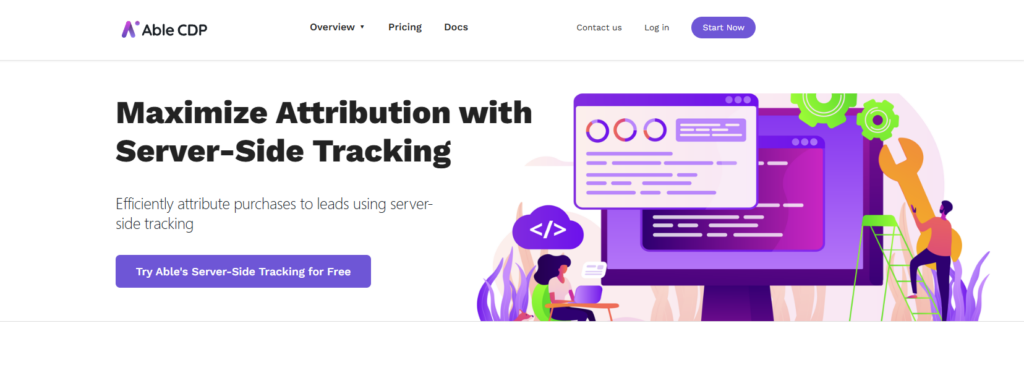
Able CDP is a server-side tracking and marketing attribution platform built specifically for performance marketing teams. Its focus is on tracking the full customer journey, from the first ad click to the final purchase. This includes delayed or higher value conversions that often get lost in traditional setups.
What makes Able stand out is its hybrid approach. It combines client-side and server-side tracking to improve data completeness and match quality, rather than relying on server-side tagging alone. The goal is to ensure that purchases are accurately attributed to the correct marketing source, even when the buying journey is not immediate.
Able integrates directly with platforms like Meta, Google Ads, and TikTok through their APIs, sending true server-side conversion data back into the ad platforms. This helps algorithms optimise against more accurate revenue signals.
Because it tracks revenue events across the entire journey, including repeat and delayed purchases, Able is particularly valuable for businesses where customer value extends beyond a single session.
Why they are a good choice
- Combines client-side and server-side tracking to improve attribution accuracy across the full customer journey
- Sends true server-to-server conversions directly into Meta, Google Ads, and TikTok APIs
- Tracks delayed and higher value purchases that many tools miss
- Designed specifically for performance marketers focused on revenue visibility
- Helps close reporting gaps between your store and ad platforms
2. Stape

Stape has become one of the most widely used server-side tracking tools, particularly for teams already using Google Tag Manager. It essentially simplifies the process of hosting and managing a server-side Google Tag Manager container.
Instead of building everything manually on cloud infrastructure, Stape provides a more accessible pathway to server-side implementation. For marketers transitioning from traditional pixel tracking, this can feel like a manageable next step. You still work within the GTM ecosystem, but with improved data control and reduced dependency on browser-side scripts.
Stape also supports integrations such as Meta Conversions API and other ad platform endpoints, making it practical for agencies managing multiple ad accounts. This tool works best for teams that are comfortable with Google Tag Manager but want to move toward server-side tracking without building a fully custom backend solution.
For many agencies, this becomes the most realistic first step into server-side tracking because it builds on an ecosystem they already understand.
Why they are a good choice
- Simplifies server-side Google Tag Manager hosting without custom infrastructure
- Prebuilt templates for Meta CAPI, GA4, and other ad platforms
- Supports Signals Gateway and CRM data integrations
- Includes monitoring, debugging, and bot filtering tools
- More affordable and accessible than fully custom server setups
3. Hyros

Hyros approaches tracking from an attribution-first perspective. While it relies on server-side tracking infrastructure, its positioning is more focused on giving marketers a clearer view of the entire customer journey.
It is particularly popular among businesses running high-ticket offers, webinars, info products, and complex funnels where the buying journey spans multiple sessions and touchpoints.
Hyros tracks users across different stages of the funnel and connects ad spend to actual revenue events. This is especially useful when browser tracking underreports purchases or when users move between devices.
For businesses where one lost conversion can mean thousands in missed revenue, the improved visibility can justify the investment. Hyros is ideal for brands running longer sales cycles or advanced funnels where attribution clarity directly impacts scaling decisions.
Why they are a good choice
- Advanced multi-channel attribution built for complex funnels
- Tracks calls, demos, subscriptions, and high-ticket sales
- Connects ad spend directly to real revenue, not just surface conversions
- Strong visibility for longer buying journeys
- Built for businesses scaling paid ads aggressively
4. Triple Whale
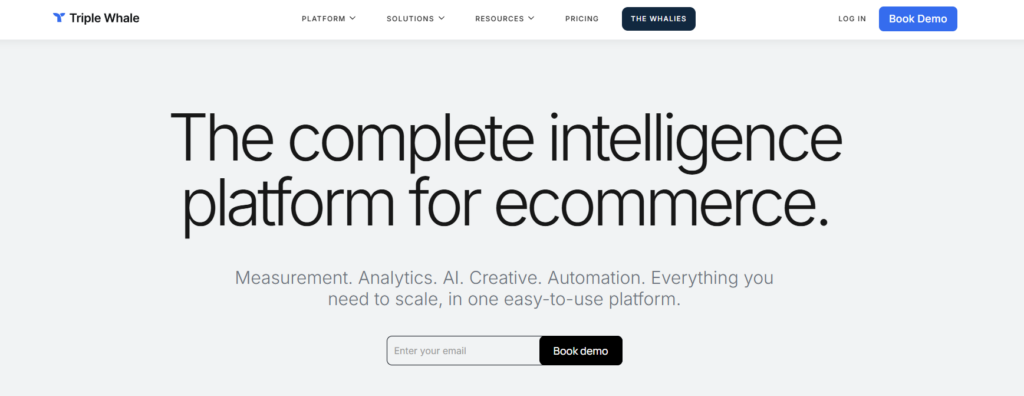
Triple Whale has gained strong traction in the ecommerce space, especially among Shopify brands. While it is often recognised for its dashboard and profit analytics, it also incorporates server-side tracking to improve attribution accuracy.
By pushing conversion events directly from backend systems, it reduces reliance on fragile browser pixels. For ecommerce brands managing multiple ad channels, Triple Whale provides a consolidated performance view that connects ad spend with revenue and customer lifetime value.
The benefit here is not just better tracking, but clearer business intelligence. Instead of switching between multiple ad managers, brands can see performance in one centralised platform.
Why they are a good choice
- Centralised ecommerce dashboard with ad, revenue, and LTV data
- Server-side tracking designed for Shopify brands
- Built-in creative and cohort performance analysis
- Strong multi-touch attribution modelling
- Clear profit-focused reporting beyond basic ROAS
5. Segment
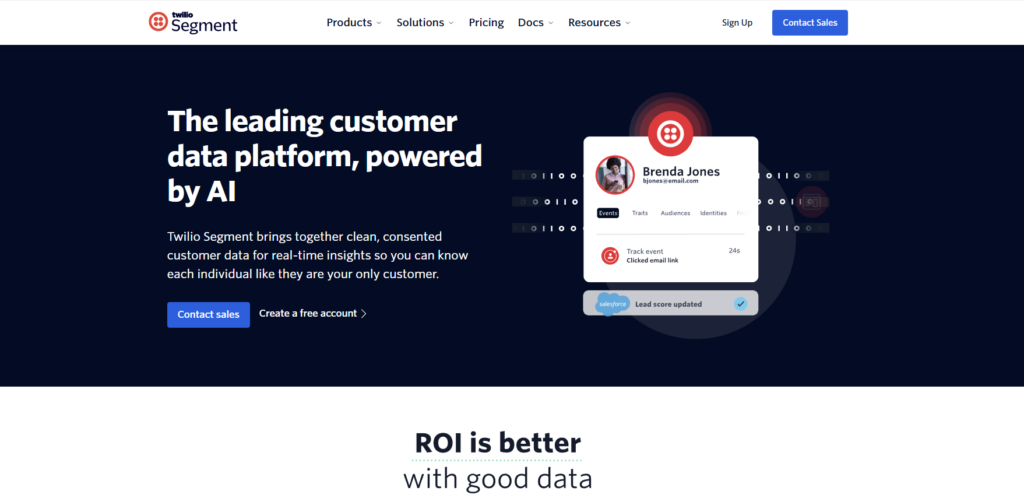
Segment is one of the more established customer data platforms in the analytics ecosystem. Unlike many plug-and-play tracking tools, Segment acts as a data infrastructure layer. It collects event data through APIs, processes it, and distributes it to marketing, analytics, and advertising platforms.
Because it operates server-side, it gives companies significant control over how data is structured, enriched, and routed. This can dramatically improve data consistency across platforms.
However, Segment typically requires engineering resources to implement and maintain. It is not designed for quick, no-code deployment. Segment is best for mid-sized to enterprise businesses that want complete ownership of their data architecture and have technical teams available to support it.
Why they are a good choice
- Enterprise-grade data pipeline with full API control
- Routes clean server-side event data to multiple platforms
- Strong identity resolution and data unification
- Highly customisable for advanced attribution setups
- Ideal foundation for large-scale marketing analytics
6. Google Tag Manager Server-Side
For teams that want maximum control, implementing Google Tag Manager in a server-side environment is another strong option. Instead of firing tags directly from a user’s browser, events are sent to a server container first. From there, they are processed and forwarded to ad platforms.
This setup reduces exposure to ad blockers and browser restrictions while allowing for custom data transformations and filtering. The trade-off is complexity. Proper implementation requires cloud hosting, configuration, and ongoing monitoring. For technically capable teams, however, it provides flexibility that off-the-shelf tools sometimes lack.
Why they are a good choice
- Gives full control over how event data is processed before being sent to ad platforms
- Uses first-party cookies, which helps reduce data loss from browser restrictions
- Allows custom data transformations and filtering at the server level
- Reduces page load impact compared to heavy client-side tagging
- Flexible setup that can integrate with Google Ads, GA4, Meta CAPI, and other endpoints
7. Elevar
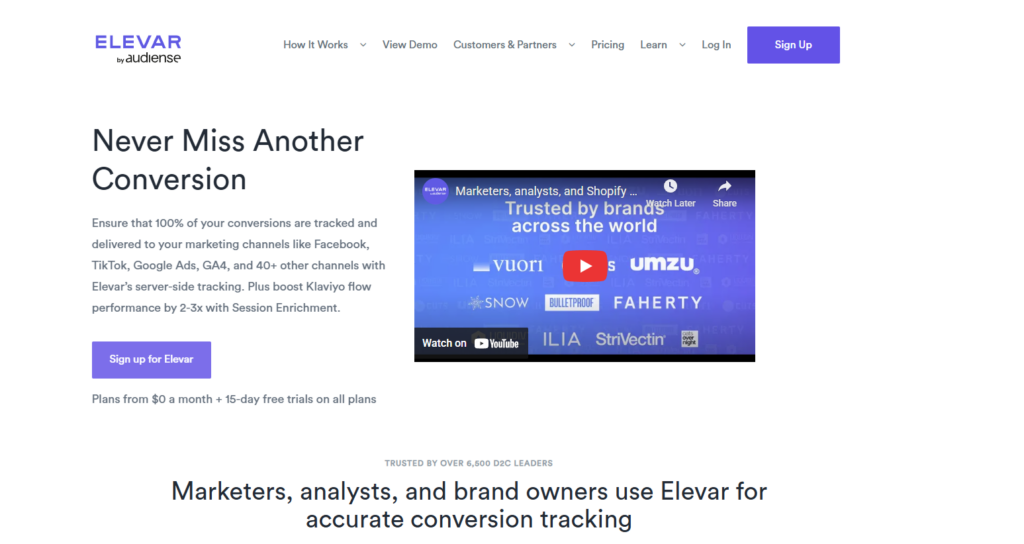
Elevar focuses heavily on ecommerce tracking, particularly for Shopify brands. Its value lies in improving data accuracy for platforms like Google Ads and Meta by sending server-side events and validating data quality. It also supports enhanced conversions and advanced ecommerce event mapping.
Many ecommerce brands experience discrepancies between their store revenue and what ad platforms report. Elevar aims to reduce that gap by ensuring cleaner event transmission and improved match rates. For brands investing heavily in paid social and search, even small improvements in tracking accuracy can significantly impact optimisation and scaling decisions.
Why they are a good choice
- Server-side tracking built specifically for ecommerce
- Improved match rates for Meta and Google Ads
- Automatic event mapping for Shopify stores
- Tracks checkout steps and customer behaviour accurately
- Helps reduce underreported conversions in ad accounts
8. Meta Conversions API
Although not a standalone platform in the same way as the others listed, Meta Conversions API plays a central role in server-side tracking strategies. By sending events directly from your server to Meta, you reduce dependence on browser-based pixel tracking. This improves event match quality and stabilises performance reporting.
Many server-side tracking tools either manage or enhance this integration. If your brand spends consistently on Meta Ads, server-side integration is no longer optional. It is part of a modern paid ads analytics stack.
Why they are a good choice
- Sends conversion events directly from your server to Meta, bypassing browser limitations
- Improves event match quality by using first-party and hashed customer data
- Reduces signal loss caused by ad blockers and cookie restrictions
- Strengthens campaign optimisation by providing more reliable conversion data
- Works alongside the Meta Pixel for event deduplication and improved accuracy
Which is The Best Server-Side Tracking Tool For Your Brand?
Not every business needs the same setup. If you are a Shopify ecommerce brand, tools like Triple Whale or Elevar may feel more aligned with your stack.
If you are an agency managing multiple clients, Able CDP or Stape can provide more flexibility. If you have strong technical resources and want complete control, Google Tag Manager Server-Side or Segment may be the better long-term play.
And if you are heavily invested in Meta Ads, implementing Conversions API properly should be a priority, regardless of the other tools you choose. At the end of the day, it comes down to three things: your technical capacity, your ad spend level, and how much attribution accuracy actually impacts your decision-making.
If you are spending modest budgets and running simple funnels, a lightweight server-side setup may be enough. If you are scaling aggressively, managing multiple channels, or operating with longer customer journeys, a more advanced attribution infrastructure can quickly pay for itself.
The goal is not to use the most advanced setup. It is to make sure your ad spend is guided by accurate revenue data rather than incomplete attribution.
The Future of Paid Ads Depends on Better Tracking
Paid ads performance is directly tied to data quality. If your tracking is incomplete, your optimisation decisions will always be limited.
The best server-side tracking tools help recover lost signals, improve attribution accuracy, and strengthen the feedback loop between your website and your ad platforms. Whether you choose a marketer-focused solution like Able CDP, a GTM-based approach through Stape, or a more advanced data infrastructure platform like Segment, the goal is the same.
Cleaner data leads to better optimisation. Better optimisation leads to more efficient ad spend. In a landscape where privacy restrictions continue to evolve and browser-based tracking continues to weaken, server-side tracking software is no longer a luxury. It is a strategic advantage for brands that take paid ads seriously.